Abundance Is a Distribution Problem
Intelligence is getting genuinely cheap. But abundance has never become justice on its own — somebody has to decide how far the wire goes.
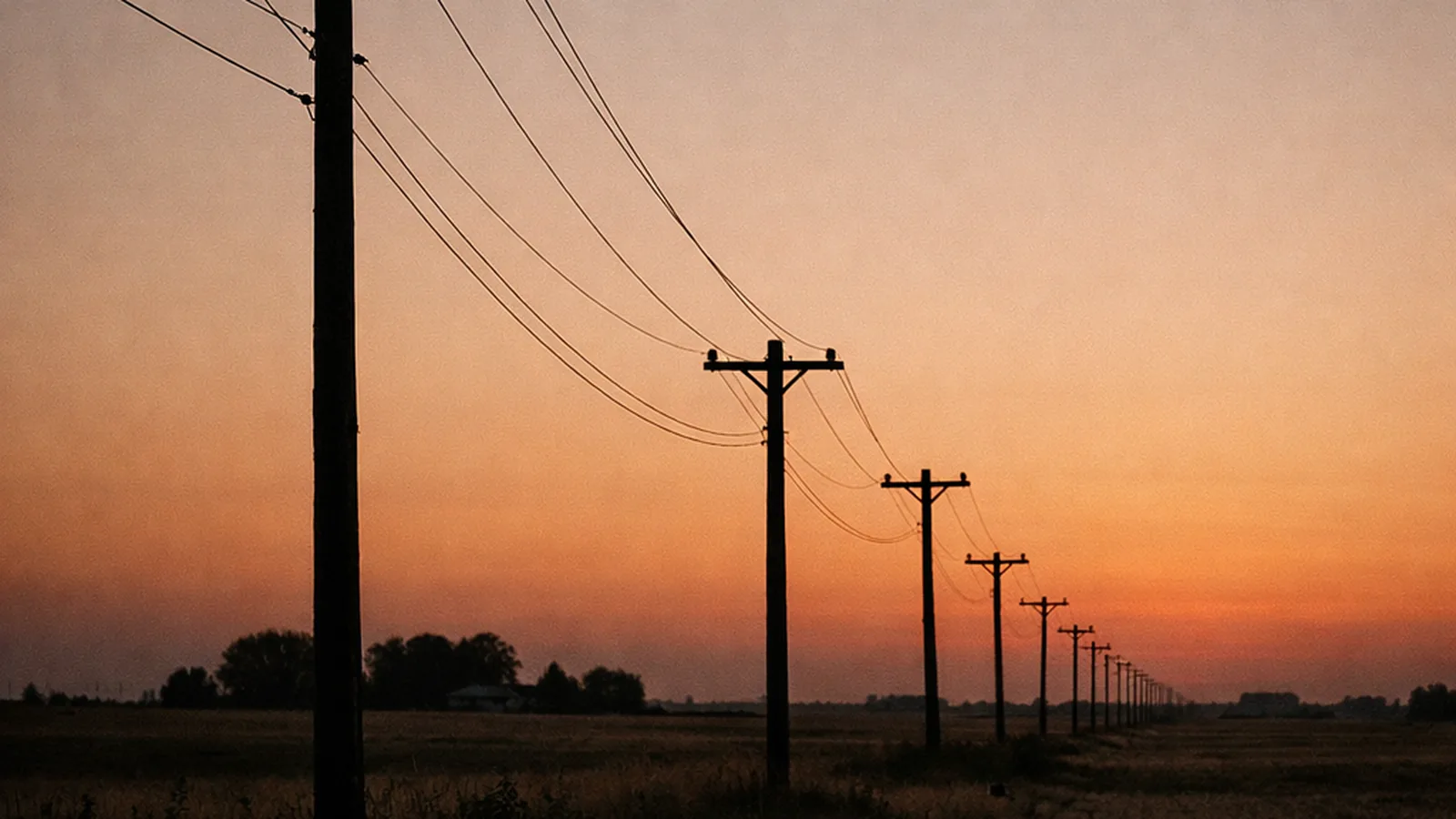
Rural America got electricity because somebody decided it should. Not because electricity got cheap — it had been cheap for decades by then. Cities had been lit since the 1880s, the price per kilowatt-hour kept falling, and none of that put a single wire on a single pole down a township road. In the mid-1930s, roughly one American farm in ten had electric service. Twenty years later it was closer to nine in ten. Nothing changed about the physics in that stretch. What changed is that the country decided rural electrification would happen and built the financing for it — long-term loans on terms that made it worth a cooperative’s while to string copper past houses no investor-owned utility would ever have served, because the arithmetic never worked and never would.
I keep that close right now, because we are living through another genuine abundance, and most of the argument about it is aimed at the wrong question.
The abundance is real
I do not want to argue from a lowered expectation, so start with what is true. Machine intelligence is getting cheap the way very few things ever get cheap. The capability curve is not a projection — it already happened. Work that took a room of trained people a week now takes an afternoon. A first draft of anything, a translation, a contract read, a tutor at eleven at night for a kid whose school has one math teacher across four grade levels. Competent cognitive labor was scarce and expensive for the entire history of our species, and it is becoming plentiful and nearly free inside a single decade. It is real, and I am not going to pretend otherwise in order to sound sober.
Abundance and justice are different variables
Here is where the reasoning usually skips a step, so let me walk the whole cascade, because the argument is hiding inside it.
Abundance is a supply condition. Justice is a distribution condition. They are two different variables and there is no law connecting them. The world grows more calories per person than at any point in human history and people still go hungry — modern famine is almost never a shortfall of grain, it is a failure of roads, prices, and politics. Antibiotics have cost pennies a dose for seventy years and still arrive years late in the places that need them most. Abundance did not fail in any of those cases. Distribution did.
An abundant good still needs a delivery system, and delivery systems get built by people who need a reason to build them. The cost of producing one more unit collapses. The cost of reaching one more person does not, because reaching a person is a fixed cost — poles, wire, a transformer, or in our case bandwidth, a device, a workflow that assumes you exist, and somebody nearby who knows what to ask the machine for. Fixed cost per user rises as density falls, which means the last third of people are the most expensive to serve at exactly the moment the good itself is cheapest.
Sit with that, because it is the whole thing. Cheapness makes the gap easier to close and less profitable to close, at the same time and for the same reason. Left alone, a falling price does not narrow the distance. It widens it, and it makes the widening look like nobody’s fault.
Who is standing near the outlet
The just-world question about AI is not whether there will be enough. There will be more than enough. The question is who is standing near the outlet.
Standing near the outlet is a physical position before it is anything else. It is fiber, power, a device that can hold a session, a workplace where somebody has time to learn a new tool, and a workflow designed by someone who imagined a user like you. A twelve-person accounting firm in a county seat can now do what a regional firm did five years ago — if somebody built the thing to fit twelve people instead of twelve hundred. Nobody builds that by accident. The default customer of every capable system is the dense, wealthy, already-connected one, because that is where the return is thickest. That is not conspiracy. It is gravity.
There is a second position that matters more where I work. A county can host the substation, the interconnect, the land, the water, and the tax abatement, and then watch every bit of the output leave on a fiber line the way the grain leaves on a truck and the coal left on a train. That is the oldest rural economic pattern in America: the commodity is produced here and the value is added somewhere else. Intelligence generated in a county and consumed entirely outside it is that pattern in a new costume, and it is the default unless somebody designs against it.
The choices are cheap now and closed later
Nobody votes on this. It gets decided in where the interconnect lands, in whether a campus sells capacity to the region or only to one hyperscaler, in whether the waste heat goes into a greenhouse that employs people here or into the sky, in whether the local co-op gets an allocation or just a larger bill. I am one of the people making some of those calls, on ground my family has farmed for six generations, and I am not going to pretend they are anything but choices.
They are not charity line items. They are design decisions, and design decisions run on a schedule. You lay tile before you plant, not in August when the field is drowning. A local capacity carve-out written into a term sheet costs almost nothing at the start and cannot be retrofitted at any price once the site is contracted. Every distribution question in infrastructure is cheap early and closed forever shortly after.
The Rural Electrification Act was not sentimental. It was a loan program with terms, and the cooperatives paid it back. What it did was decide that the wire should run further than the market would carry it, and then build the mechanism that carried it there. That is the entire lesson and it is not a warm one.
The abundance is coming regardless. So is the pole line — and it will run exactly as far as somebody decides it runs. Somebody is drawing those lines right now, in rooms most people will never see, and I am in some of those rooms. That is not a comfort. It is an assignment.